An analysis, written by this project
FY26 on the town side, as the books stood in June
The same ledger read for the other 67 departments. Snow at 292% of its appropriation, a Reserve Fund never touched, and school costs sitting on the town’s books.
lunenburgbudgetproject.org — written by the Lunenburg Budget Project, an independent tool for residents. Not affiliated with the Town of Lunenburg, the School Committee or the school district. The document this page renders: /docs/analyses/fy26-closeout-town.md
Working state:
notes/HANDOFF.mdcarries the current branch and what is established versus assumed.CLAUDE.mdcarries the rules.
Analysis, 2 September 2026. Companion to analyses/fy26-closeout.md, which reads the same report for the school department. Every figure recomputed by scripts/verify_fy26_closeout_town.py from sources/data/lunenburg.db.
Each section is written twice: In plain terms for anyone, and The evidence for anyone who wants to check it.
What this rests on, and what it is not
The FY26 year-to-date budget report sent by the Town Manager on 2 September 2026, at account level: 376 accounts across 67 departments, everything except the school department (300) and school non-recurring (301).
The same three limits apply as on the school side. It is period 12, not 13 — June, with the books open, before purchase orders are cleared. The Town Manager's own framing is the one to use: "figures likely to continue to adjust as we continue the year-end reconciliation process." Current, not final — and not doubtful either.
The amount that step can move is bounded by the $282,541.80 still encumbered: each purchase order is either paid, which leaves the figure where it is, or released, which raises it. The town's final unspent figure lands between $858,462 and $1,141,003. Zero-balance accounts are suppressed, so nothing here reasons from what is absent. And it is expenditures only, Fund 0100 — no enterprise funds, no grants, no revolving funds.
Nothing in this document is a surplus. It is a position.
In one page
The town finished June $858,462 under budget across 376 accounts — the residue of $1,279,769 of underspending against $421,307 of overspending. Like the school side, the total is quiet and the parts are not.
But the town gets there very differently. Only 18 of its 376 accounts went over budget. On the school side it is 57 of 259 — one account in five, against fewer than one in twenty. That difference is a fact with at least four explanations and this document does not choose between them.
Snow removal is the year's outstanding number. Budgeted at $355,571, given $520,319 more during the year, and it still finished $162,521 over — $1,038,092 spent, 292% of the appropriation. The wages line alone spent 539% of its budget with no transfer at all.
The Reserve Fund was never touched. $185,000 of declared contingency, $0 spent, in the year snow ran $682,521 past its appropriation. With the retirement buy-back reserve that is $215,000 of unused contingency — a quarter of the town's entire net underspend. That is stated as a fact rather than a criticism: a Reserve Fund transfer needs a Finance Committee vote and snow deficit spending does not.
$3.3 million left the operating budget for capital projects and stabilization, against $1,285,000 appropriated for the purpose. It is the largest single movement in the FY26 books.
And $1,262,376 of school retiree health insurance sits in a town department — a real cost of running the schools, invisible in the school budget the School Committee votes on. An unknown share of the town's remaining $2,336,409 of insurance is for serving school staff; the accounts do not separate town from school. This is the first time this project has been able to point in the ledger at any of the gap between the state's all-funds figure for Lunenburg and the appropriation.
These figures are current rather than final, and this document holds them the way the Town Manager did when she sent them: "figures likely to continue to adjust as we continue the year-end reconciliation process." What can change is bounded by the $282,542 still encumbered, so the town's final unspent figure lands between $858,462 and $1,141,003. Current, not doubtful.
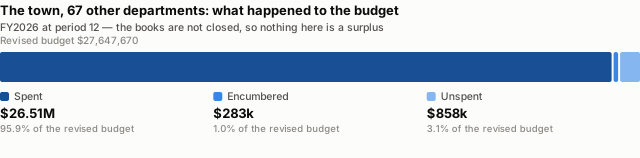
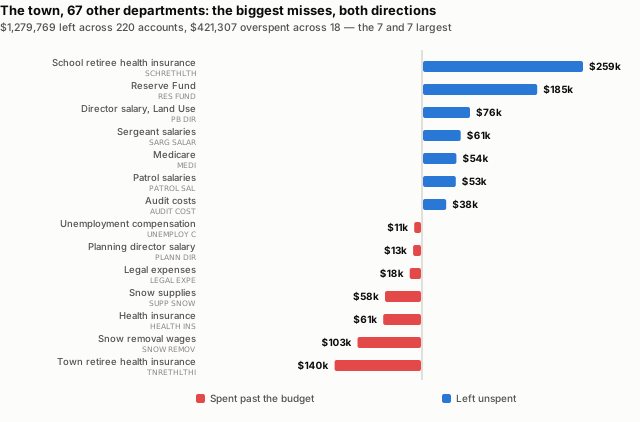
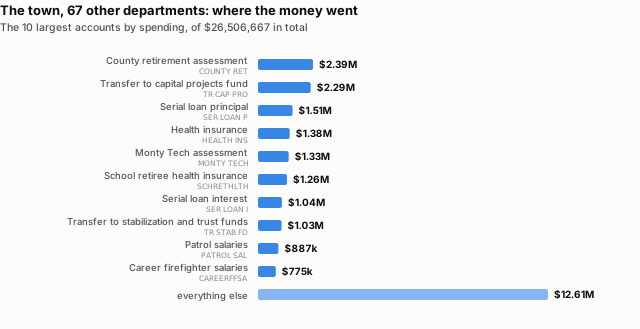
These three pictures are the whole document in outline. The first shows that almost all of the budget was spent. The second shows that the small leftover is the residue of large movements in both directions. The third shows what the money bought. Everything below is those three facts, itemised and sourced.
1. The town underspends differently from the schools
In plain terms
Both sides came in under budget. They got there in completely different ways.
On the town side, 220 accounts were under and only 18 were over. On the school side, 160 were under and 57 were over. About one school account in five overspent; on the town side it is fewer than one in twenty.
The evidence
| accounts | under | accounts | over | net | |
|---|---|---|---|---|---|
| Town, 67 departments, 376 accounts | 220 | $1,279,769 | 18 | $421,307 | $858,462 |
| Schools, 259 accounts | 160 | $1,683,534 | 57 | $1,219,295 | $464,239 |
Both rows are departments 300 and 301 excluded or included consistently. The companion school analysis covers department 300 alone — 258 accounts, 56 over, $1,201,434 — because 301 is a single separate appropriation. Adding it moves the school row by one account and $17,862, and that account is CURR ADOPT, curriculum adoption, which spent $43,639 against a revised $35,777.
Town totals at period 12: $24,902,491 appropriated, $2,745,179 transferred in, $27,647,670 revised, $26,506,667 spent, $282,542 encumbered, $858,462 unspent, across 376 accounts in 67 departments.
What this does not show
Why. Four readings fit and nothing here separates them: school budgets may be set tighter against known costs; the town may transfer more readily during the year so an account never shows as over; the two may code differently, with the schools carrying more small accounts that can each tip negative; or school costs may simply be less controllable. The ratio is a fact. The explanation is not.
2. Snow removal cost $1,038,092 against a budget of $355,571
In plain terms
Snow was budgeted at $355,571. It was given $520,319 more during the year. It still finished $162,521 over — total spending of $1,038,092, which is 292% of what the town appropriated.
It is the single largest budget miss in the FY26 town books, and it is bigger than the school department's entire net underspend.
The evidence
| account | original | transferred in | revised | spent | left | |
|---|---|---|---|---|---|---|
531003 | CONTR SERV | $114,500 | +$381,730 | $496,230 | $496,230.00 | $0 |
531029 | SUPP SNOW | $205,151 | +$138,589 | $343,740 | $402,039.54 | −$58,300 |
513000 | SNOW REMOV (wages) | $23,420 | $0 | $23,420 | $126,286.35 | −$102,866 |
531030 | HIRED SNOW | $7,500 | $0 | $7,500 | $9,174.15 | −$1,674 |
531006 | PURCH SERV | $5,000 | −$319 | $4,681 | $4,362.42 | +$319 |
| department 423 | $355,571 | +$520,000 | $875,571 | $1,038,092.46 | −$162,521 |
Two things in that table are worth reading closely.
CONTR SERV was given $381,730 and then spent exactly $496,230.00, to the penny of its revised budget. A transfer sized precisely to what was spent is what a year-end transfer looks like: the budget is moved to cover the actual, not the other way round.
SNOW REMOV — the wages line — got no transfer at all and spent 539% of its $23,420 budget. It is the account most over its appropriation anywhere in the town books.
What this does not show
Snow and ice is the one thing a Massachusetts town may lawfully overspend, which is why this department can end a year negative where others cannot. We hold no document stating that authority, and it is named here as the ordinary explanation rather than as something this project has verified.
Nor does this say the winter was severe. It says what was spent.
3. The Reserve Fund was never touched
In plain terms
The town budgeted $185,000 as a Reserve Fund — the contingency it holds for unforeseen costs. At the end of June it had spent nothing. Not one dollar.
In the same year snow removal ran $682,521 past its original appropriation.
The evidence
| department | account | budgeted | transferred out | spent |
|---|---|---|---|---|
132 RESERVE FUND | RES FUND | $185,000 | $0 | $0.00 |
133 SALARY RESERVE | RES FUND | $180,000 | −$128,953.67 | $51,046.33 |
133 SALARY RESERVE | RETIRE/BUY | $30,000 | $0 | $0.00 |
The salary reserve did its job: it gave away $128,954 of its $180,000 and spent the rest. The Reserve Fund proper did nothing, and the retirement buy-back reserve did nothing.
$215,000 of contingency went unused, which is 25% of the town's entire net underspend.
What this does not show
That this is a finding rather than a procedure. A Reserve Fund transfer requires Finance Committee approval, and snow deficit spending does not — so a town facing a snow overrun would not necessarily reach for it. Whether $185,000 sitting idle reflects a deliberate policy, an unspent contingency in a mild year, or a reserve nobody asked to use, is not established here.
4. $3.3 million left the operating budget for capital and reserves
In plain terms
Two accounts exist to move money out of the operating budget: one into capital projects, one into stabilization and trust funds. Between them they were budgeted $1,285,000 and moved $3,321,257 — more than two and a half times as much.
This is the largest single movement in the FY26 town books, and it is money the operating budget raised and then sent somewhere else.
The evidence
| department | original | transferred in | spent | |
|---|---|---|---|---|
993 | Transfer to capital project fund | $1,052,500 | +$1,240,820.32 | $2,293,320.32 |
996 | Transfer to trust and stabilization | $232,500 | +$795,437.00 | $1,027,937.00 |
| together | $1,285,000 | +$2,036,257.32 | $3,321,257.32 |
Both spent their revised budget to the dollar, which is what a transfer account does: the money arrives and immediately leaves.
What this does not show
Where the incoming $2,036,257 was voted from. These accounts received more than they were appropriated, so something outside the original appropriation funded them — free cash, a stabilization draw, a Town Meeting article. The ledger records that the budget changed and never records the counterparty. That is the same gap the school department's transfers run into, and the same document would close it.
5. The schools cost the town money the school budget never shows
In plain terms
The town's insurance department spent $3,598,785 in FY26. Of that, $1,262,376 is explicitly school retiree health insurance — a real cost of running the schools, sitting in a town department, appearing nowhere in the school budget the School Committee votes on.
An unknown share of the remaining $2,336,409 is health insurance for serving school employees. The account names do not separate town from school, so it cannot be measured.
The evidence
| account | revised | spent | left | |
|---|---|---|---|---|
570018 | SCHRETHLTH — school retiree health | $1,521,536 | $1,262,376.00 | +$259,160 |
570001 | HEALTH INS | $1,315,270 | $1,376,557.17 | −$61,287 |
570009 | TNRETHLTHI — town retiree health | $453,215 | $593,088.85 | −$139,874 |
570003 | MEDI | $400,000 | $345,848.60 | +$54,151 |
570002 | LIFE INS | $15,000 | $12,864.84 | +$2,135 |
| four smaller accounts | $8,049.98 | |||
| department 914 | $3,598,785.44 |
Elsewhere, department 210 carries SCHRESSTIP at $6,800 — a school resource stipend in the police budget.
False friends, checked and discarded. Nine town accounts match a search for SCH. Two are the ones above. The other seven are named MTGS/SCHOO, MTG/SCH FF, MEET/SCHOO — meetings and schooling, meaning staff training, not schools. They total $9,944.81 and are excluded. A name match is a candidate, not a finding.
Why this matters beyond the money
This is the mechanism behind a number this project has had to be careful with. DESE reports Lunenburg's FY24 in-district spending at $26,914,321.89 against a general fund school appropriation of about $22.8M, and the difference is not hidden money — it is costs like these, which DESE attributes to the schools and the school budget does not carry.
$1,269,176 of it can now be named. The rest cannot, and this is the first document in this project able to point at any of it in the ledger.
What this does not show
How much active school employee insurance is in the $1,315,270 HEALTH INS line. The account does not split town from school. It could be most of it or little of it.
6. Spending against a zero budget — and why the school case is still different
In plain terms
analyses/fy26-closeout.md §3 reports two kindergarten paraprofessional accounts that spent $99,064 with no appropriation and no transfer. The obvious question is whether that is unusual, so it was checked against the town side.
Thirteen non-school accounts spent money with no original appropriation. Eleven of them received a transfer that covered it. The remaining two are one event, not two — and it is not the same event as the kindergarten accounts at all.
The evidence
Eleven were covered by a transfer, and that is the ordinary mechanism working:
| department | account | transferred in | spent |
|---|---|---|---|
164 Town Clerk | TN CLK SAL | +$80,629 | $78,466.44 |
992 | TR SPE REV | +$15,000 | $15,000.00 |
136 | AUDIT COST | +$8,500 | $8,500.00 |
170 | CONSULTANT | +$8,971 | $8,187.54 |
141 | TEMP SALAR | +$13,347 | $4,276.20 |
136 | GASB45VALU | +$4,100 | $4,100.00 |
| … | five smaller |
The two without a transfer are both in the Planning Board, and they cancel:
| account | original | transfers | spent | |
|---|---|---|---|---|
511000 | PLANN DIR | $0 | $0 | +$12,796.80 |
511001 | PLAN CLERI | $0 | $0 | −$12,796.80 |
Those are the department's only two accounts in this report, and the second is the exact negative of the first. That is a reclassification — a salary posted to one account and journalled out of another — and it nets to nothing. No money was spent without a budget; money was moved between two accounts that both happen to carry no budget.
What this changes about the school finding
It makes the kindergarten case more unusual, not less. The one town-side example that looked like the same thing turns out to be a paired journal entry that cancels.
There is no offsetting negative anywhere in the school department. Every account in department 300 has zero or positive spending; not one carries a credit that would net the kindergarten accounts off against something else. Checked directly, because it is the first thing that would have explained them.
So on the town side, spending against a zeroed line is either covered by a transfer or is half of a recode. In the school department, $99,064 is neither.
7. Money not spent on people
In plain terms
The Town's explanation for the FY25 surplus was unfilled posts: "significant turnover and unfilled positions in the facilities department resulted in unspent salaries and stalled maintenance projects." Read against FY26, the town side gives a cleaner picture than the school side does — and it does not support the same story.
Salary accounts under budget hold $378,959, which is the ceiling on unfilled-post savings. Salary accounts over budget hold $120,923, so the net left on personnel is $258,036 — about 30% of the town's net underspend.
Almost none of it is a post that went unfilled all year. Only two salary accounts spent nothing at all, and they hold $4,440 between them. Everything else is a line that paid somebody for part of a year.
The evidence
| accounts | amount | |
|---|---|---|
| Salary accounts under budget | 45 | $378,959 |
| Salary accounts over budget | 7 | $120,923 |
| Net left on salaries | 52 | $258,036 |
The largest partial spends:
| department | account | budget | spent | left | |
|---|---|---|---|---|---|
170 Land Use | PB DIR | $104,911 | $28,793 | 27% | $76,118 |
210 Police | SARG SALAR — sergeant salaries | $329,083 | $267,994 | 81% | $61,089 |
541 Council on Aging | SALASSTMEA | $21,080 | $4,147 | 20% | $16,933 |
170 Land Use | CONS ADMIN | $67,094 | $52,884 | 79% | $14,210 |
541 Council on Aging | MEAL SITE | $44,973 | $30,867 | 69% | $14,106 |
541 Council on Aging | OUT WORKER | $42,629 | $28,910 | 68% | $13,720 |
650 Parks & Recreation | PARK SUPER | $23,208 | $13,029 | 56% | $10,179 |
PB DIR at 27% of a $104,911 salary is the largest single personnel underspend in the town books, and the Land Use department also holds CONS ADMIN at 79%.
The FY25 explanation does not repeat in FY26
The Town named the facilities department, and in FY26 Facilities & Grounds spent its salary budget to the dollar:
| account | budget | spent | left | |
|---|---|---|---|---|
SALFACDIRE | Facilities salaries | $123,250 | $123,250 | $0 |
DIR FAC SA | Facilities director salary | $68,966 | $68,966 | $0 |
SAL STAFF | Facilities staff salaries | $46,772 | $46,772 | $0 |
Three accounts, three exact matches, nothing left on any of them. Whatever produced FY26's underspend, it is not the mechanism the Town identified for FY25.
The two sides differ here as they do everywhere
| under | over | net | share of the side's net | |
|---|---|---|---|---|
| Town salary accounts | $378,959 | $120,923 | $258,036 | 30% |
| School salary accounts | $573,623 | $399,162 | $174,460 | 36% |
Personnel is about a third of each side's underspend. But the school department has 38 salary accounts over budget against the town's 7, which is the same pattern §1 found across all accounts, concentrated in the place where it is most consequential.
What this does not show
That any post was vacant. A partial spend is consistent with a post filled in October, a resignation in April, a part-time appointment, or a person appointed at a lower step, and nothing here separates them. A budget line is not a position.
What would settle it
Budgeted positions with their fill dates, or the payroll register by account.
8. Which lines give their money away
In plain terms
A line budgeted high and then handed to something else is doing a contingency's job without being called one. In FY26, 85 town accounts gave up $758,421 — two and a half times what the school department released, across two and a half times as many accounts.
But one year cannot show whether any of it is habitual, and the clearest example on this side is not over-budgeting at all.
The evidence
The accounts that gave away the largest share of what they started with:
| department | account | started with | gave up | left | |
|---|---|---|---|---|---|
411 Highway | ADAPROW | $30,000 | −$30,000 | 100% | $0 |
425 Traffic signs | LINE PAINT — line painting | $17,500 | −$17,500 | 100% | $0 |
945 | TRAINING | $5,000 | −$5,000 | 100% | $0 |
145 Treasurer | BOND ISSUA — bond issuance costs | $2,500 | −$2,500 | 100% | $0 |
193 Facilities | SAL OVERTI — facilities overtime | $2,083 | −$2,083 | 100% | $0 |
161 Town Clerk | SAL ELECTE — elected officials' salaries | $80,629 | −$78,466 | 97% | $2,163 |
541 Council on Aging | MILEAGE | $3,800 | −$3,000 | 79% | $800 |
The largest one is a recoding, not a release
SAL ELECTE gave up $78,466 — and in a different department, TN CLK SAL received $80,629 and spent $78,466. The two match: the Town Clerk's salary moved from an elected-salaries line in department 161 to a Town Clerk line in department 164. Nothing was over-budgeted. Something was renamed, and the ledger shows it as a large transfer out of one line and into another.
That is the caution the whole section needs. A line at 100% given-up looks identical whether it was padded, recoded, or genuinely not needed, and only the transfer schedule — which names the counterparty — separates them.
What this does not show
That any line is consistently over-budgeted. Every figure above is one observation. The archive holds one year at account level, and CLAUDE.md rule 6 is explicit that a rate off one or two points is not a trend.
Nor which of these was a Reserve Fund transfer. The town has declared contingencies — the $185,000 Reserve Fund untouched in §3, the $180,000 salary reserve that gave away $128,954 — and a line released by ordinary departmental transfer is a different thing from one released by a Finance Committee vote. The ledger does not distinguish them.
What would settle it
FY24 and FY25 at the same grain, and the transfer schedule that names each counterparty.
What this means
For a resident
The town's books are tighter than the schools', and that is visible rather than asserted. Eighteen accounts over budget out of 376. Whether that reflects steadier costs, readier mid-year transfers, or a different way of coding the same thing is not established here — but the pattern is real and it is the clearest structural difference between the two sides.
Snow is the one line a town may lawfully overspend, and Lunenburg used it heavily. It cost nearly three times its appropriation. That is not a failure of control; it is what the mechanism exists for. It does mean that when the town budgets $355,571 for snow, the figure is a placeholder rather than a forecast.
Part of what the schools cost is on the town's side of the ledger. $1,262,376 of school retiree health insurance, plus an unmeasured share of active employee insurance. Anyone comparing the school budget to what the state says Lunenburg spends on schools is looking at that difference, and this is where some of it lives.
For the Select Board and Finance Committee
$215,000 of declared contingency went unused in a year with a $682,521 snow overrun. There is a good procedural reason — the Reserve Fund needs a vote, snow deficits do not — but it is worth knowing that the town carried an untouched reserve through its most expensive weather event of the year.
The transfer schedule is the missing document, and it is missing for the same reason on both sides. Every "transferred in" figure in this analysis has an unrecorded counterparty, including the $2,036,257 that arrived in the two accounts that move money to capital and stabilization. The ledger records that a budget changed; only the schedule records what it changed against. It was tabled at Finance Committee on 11 June for want of documents and has not surfaced since.
Health insurance should be split between town and school employees in the accounts. It is the single largest unmeasured school cost in the town books, and the split is not a new report — it is a coding question about accounts that already exist.
For a department head
A line that gives away 100% of its budget looks the same whether it was padded, recoded, or genuinely not needed. The clearest case here is not over-budgeting at all: the Town Clerk's salary moved between two lines in different departments, and it appears in the ledger as a $78,466 give-up. Where a transfer is a reclassification rather than a release, the transfer schedule is the only thing that says so.
Facilities is the line this document can point to as working. Three salary accounts, three exact matches, nothing left on any of them — and it is also the department the Town named as the cause of the FY25 surplus. Whatever happened last year did not happen this year.
One year cannot show a pattern. Nothing here says any line is habitually over-budgeted, and three years at this grain is the only thing that would.
What would change these findings
- The FY26 period 13 report. Every figure here is a position, not a result.
- The year-end transfer schedule. Settles §2, §4 and §6 — every "transferred in" figure above has an unknown counterparty.
- A split of health insurance between town and school employees. Settles the open half of §5, and is the largest single unmeasured school cost in the town books.
- Finance Committee minutes from 14 July 2026.
- Budgeted positions with their fill dates, or the payroll register by account. Turns §7's ceiling into a measurement.
- FY24 and FY25 at account level. §8 can show which lines gave money away once; only three years can show which do it habitually.
How to reproduce
python3 scripts/builddb.py python3 scripts/verifyfy26closeouttown.py
Where this came from
Nothing on this page is an official document. It was written here, from documents the town and district published and from records obtained by request, and it has not been reviewed or endorsed by the Town of Lunenburg, the School Committee, the Finance Committee or Lunenburg Public Schools. The report index says the same thing at more length, and lists every analysis alongside the data underneath it.
This page renders the document itself, which is the source of truth: there is one copy of every sentence and every figure here, not a transcription of one. Every figure in it is recomputed from the underlying data by python3 scripts/verify_fy26_closeout_town.py, which fails rather than warns.
Every other report
Every analysis this project has written, in one index, is at reports.